

Harvard Medical School has examined the financial costs of unmanaged sleep apnea in the following report.

Executive Summary
- Like all meta-analyses, this work relies on the quality of existing data – we focused on areas where the link between the disease and the costs incurred are the strongest. This includes:
- Moderate – severe OSA and OSAS (AHI ≥ 15 or OSA Syndrome)
- Does not include mild OSA and costs that are difficult to size (e.g., presenteeism, impact on family life, marriage, etc and other societal costs)
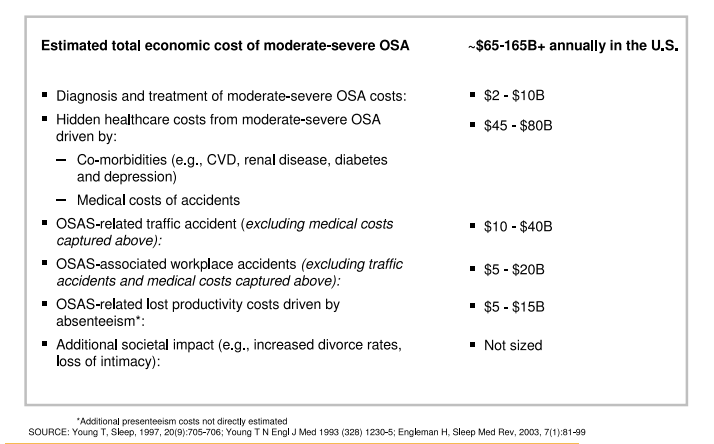
- We estimate the annual economic cost of moderate – severe OSA in the United States to be $65 – $165B, which are greater than asthma, heart failure, stroke and hypertensive disease ($20B to $80B)
- Yet, OSA attracts limited public attention (e.g., OSA related traffic accidents cost ~$35B versus well-known public safety threats such as drunk driving ($60B) and not wearing seatbelts ($150B))
- Awareness, diagnosis, and treatment of OSA are limited by the economics and nature of the condition
- OSA costs are highly fragmented and touch many disconnected stakeholders
- Current technology, while effective at treating the disease, is cumbersome and uncomfortable for many
- Low patient compliance limits the cost effectiveness of treatments for payors
- Opportunities to reduce the costs of sleep apnea include:
- More holistic research to understand the current and projected costs of the disease (e.g., prevalence, co-morbidities)
- Building a cohesive community of stakeholders (e.g., physicians, patients, employers, public safety officials, etc) to drive awareness
- Improving the patient experience and comfort in treatment to drive adoption
- Convincing payors and employers of the long-term economic benefits of screening and treatment
Total economic costs of moderate-severe OSA
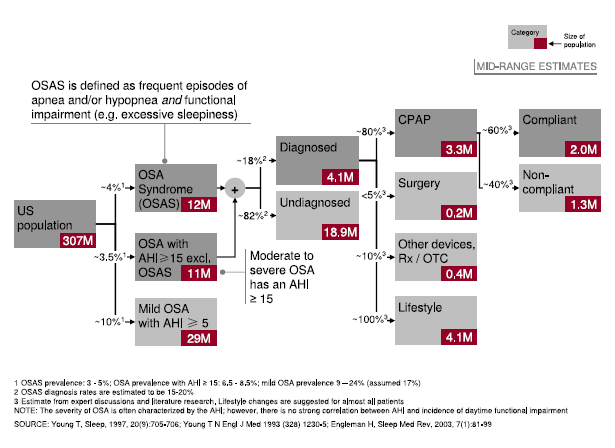
Obstructive Sleep Apnea is a significant, yet under-diagnosed and under-treated chronic disease in the US
To view the full report “The Price of Fatigue”, or for more information from the Harvard Division of Sleep Medicine, visit: https://sleep.med.harvard.edu/what-we-do/public-education